Sunday, October 28, 2012

Civil Disobedience: Is it Wisdom or plain Disobedience?


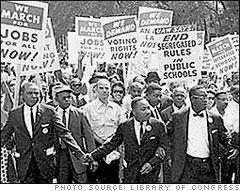
Henry David Thoreau's Civil Disobedience was very influential to people such as Martin Luther King Jr. and Gandhi, both of whom were revolutionary leaders.  It basically said that, if you think a law is unfair, then you should not follow it.  Of course, there have been laws in history that were unfair, like segregations laws and--to go back even further--slavery.  However, not every law the government makes is unfair.  In fact, most laws are very helpful and are made for a reason.  So what Thoreau is suggesting is, whenever a person feels a law is unfair, they should simply not follow it.  That could cause some major problems.  Imagine this situation in the mind of a teenager who has to follow her parents rules.  Perhaps she has a set curfew that her parents made, but the teenager doesn't find it very fair because she thinks she is responsible enough to be out late.  If this teenager followed Thoreau's advice, she would ignore her parents rules and stay out as late as she wants.  I'm sure we can all see that this would end badly.  Even though this teenager thinks the curfew is unfair to her, she doesn't realize her parents are protecting her from things she doesn't understand, and therefore the curfew is a good thing for her.  If every citizen just decided to not follow any law they thought was unfair, the country would be full of murderers and thiefs and lairs who would justify the crimes they commit by saying the laws aren't fair, and that would just be a mess!   

Sunday, October 21, 2012

What's the Point of Pep Talks?


Every type of sport or team activity I can think of uses pep talks as a way to psych up the team before a big game or competition.  Say the Troy High Basketball team is about to play their last game.  Their coach might say something along the lines of, “we’re ready for this”, “We’ve worked all season for this”, “Everyone is here for us, so don’t let them down”, and stuff like that.  But what does that really do for the players?  Even something as simple as a pep talk before a big game contains appeals.  If the coach said, “The other team has lost every game this season, so this will be easy”, he would be using a logical appeal because he used facts or statistics to motivate his team.  A coach might also use emotional appeals by saying “You know how bad it felt to lose last week!  We’re not going to let that happen again!”  This would inspire the team by stirring the emotions of the players.  Thomas Paine’s The Crisis is basically one big pep talk to the American Army.  They had been doing not so well in the war at this point, and Paine’s essay motivated them to keep fighting by using appeals like “The harder the conflict, the more glorious the triumph”, which inspires the men to fight for that glory.  Appeals can be found in almost anything that tries to persuade or motivate its audience, even things you wouldn’t expect like everyday conversations!


Sunday, October 14, 2012


Why do the Liars Always Win?

             In every movie, book, or TV show there’s always an antagonist to oppose the protagonist.  That antagonist is usually the villain who causes trouble for the hero, and usually that trouble is caused by lies and deception.  The liars in any situation always seem to get away with whatever they’ve done, while the honest people take the heat.  If two people cheat on a test, one person might lie and say they never copied off of anyone and the teacher would believe them.  Then the other person might tell the truth and say they did cheat and they would get punished.  In situations like this, it’s more beneficial to lie than it is to tell the truth, which is why lying is so tempting and doing the right thing to telling the truth can be so hard.  In The Crucible, the entire conflict in the story sprouts from the lies of one person—Abigail Williams.  All the townspeople take her word whenever she accuses someone of witchcraft, but when Proctor and Hale try to suggest she lied, they are shot down.  As the audience, we know that Abigail is lying and that none of the accused are actually guilty, but none of the characters seem to see it that way.  When Elizabeth Proctor tells the first lie of her life to protect her husband’s reputation, it ends up sending them both to their doom.  In a lot of stories, the truth comes out in the end and the good guys win and live happily ever after, but that’s not so realistic.  In real life, the liars get away with a lot while the honest people suffer, which is exactly what happens to Proctor in The Crucible.  The play is a sad but true example of how the world works. 

Sunday, October 7, 2012


Modern Day “Witchcraft” Hysteria

                When Arthur Miller wrote The Crucible, he was inspired by the Red Scare of the 1950s.  That was one example of modern day witchcraft hysteria, minus about 60 years.  During the Red Scare government officials accused anyone and everyone of being communist.  The accusations became illogical and frankly, ridiculous, just like the accusations of witchcraft in The Crucible became a frenzy of “he said-she said”.  There are even more recent examples of this mass hysteria in history, and even some that are still going on today.

                Ever since the terrorist attacks on September 11th, a new stereotype has been placed on people of Middle Eastern and Indian descent: terrorist.  The hysteria has calmed down a bit since then, but in the years following 9/11, almost all Middle Eastern people were cast out of society and suspected by others as terrorists, even though hardly any were.  They were discriminated against at air ports, among other places, because supposedly they were all suicide bombers who wanted to blow up America.  Of course, this was completely untrue for the majority of the population, but people still felt this way toward this specific group of people.  Accusations of being a terrorist became completely impulsive with no proof whatsoever.  This is what Arthur Miller depicts in The Crucible.