Sunday, November 25, 2012


Where is the line between Protection and Deception?

In Billy Collin's "The History Teacher", a history teacher tries to protect the innocence of his students by hiding the truth about all the crude and imperfect events in history. This history teacher had good intentions, but the poem also explains that the students--the innocent children that the teacher is trying to protect--are already bullying other kids on the playground and therefore are not innocent at all. This poem is ironic because, by lying to the students, the teacher is hurting them more than he would if he told them the truth. When he covers the events of the past, the children don't know that conflict can lead to war and destruction, and therefore think it's ok to bully. This same concept of lying to protect the innocence of a group of people is used by Dimmesdale in The Scarlet Letter. Dimmesdale conceals his affair with Hester from his congregation in order to protect their view of the Puritan church as good and Holy. If he told them what he did, the congregation would lose their faith in religion and stray away from it. Dimmesdale lied to protect them from the flaws in human nature, but by lying he only denies them the knowledge of their worst enemy: their own flaws in character. The congregation should know that no one is perfect, but they idolize and come to believe in something that doesn't exist: a man without flaws. The poem also reminds me of 1984 by George Orwell, in which the government not only lies about the events in history, but completely rewrites them. In 1984, the government controls everything and no longer lies to protect the people, but lies to protect the government itself. This is the extreme of a lie with a good intention, and what the lies in "The History Teacher" could escalate to in an extreme case.

Sunday, November 18, 2012

What is Real Bravery?


Harriet Jacob's slave narrative is effective in showing the hardships of slavery, but I'm not sure I can call her brave. She ran away, but left her children--knowing her old master would go buy them to try to lure her back! She claimed she ran away so that her children could be free, and eventually they were, but first they had to go through weeks in jail! I feel like a mother should never leave her children in the hands of an angry man out for revenge. It seems to me that running away and leaving her children behind was the easy way out. Of course, I have no right to criticize; being a slave would have been awful and I can't say that I wouldn't have done the same thing.

Most of the time when we think of bravery, we think of heroes who fight for the greater good and the people they love, but could running be as brave as fighting?  I have my own feelings about Jacob's decision to run away, as I just stated, but she did have a good reason.  The alternative--which would be to rebel against her slave owner and literally fight for her freedom--would have been pointless.  One woman like Jacobs could not have fought against her slave owner.  She would have been beaten and her children would most likely have been punished also.  She couldn't have taken her children with her either because it would have been too hard to hide herself and her children.  It was safer for them to stay behind than to be on the run.  Considering her scenario, Jacob's decision to run away by herself was probably the best decision for her children.  It wasn't necessarily lacking bravery either, because to be brave is to do things you are scared of doing.  I'm sure leaving her children behind scared Jacobs to death!  So in a way, I suppose she was brave.


Sunday, November 11, 2012

Reverse Psychology In Grammar?
The article we read in class about semicolons really got me thinking about the rights and wrongs in grammar. There are obviously rules that we have to follow when constructing a sentence, without which the sentences would be incorrect. There are also some aspects of grammar that are stylistic, and don't have definite rules to go by. A writer has to choose what kind of sentences he or she will use in his or her writing: simple, complex, compound complex? There are also many differing opinions as to what is stylistically the best way to wright, but none of these can ever be truly chosen as right or wrong because there are no rules defining writing style. According to the article, Kurt Vonnegut has a very strong opinion against semicolons. There is nothing wrong with semicolons, but he vehemently opposes them! The writer of the article first agrees with Vonnegut's position because he idolizes him, but then comes to love semicolons. What I wonder is, was it the author's reading of William James that caused his change of heart toward semicolons, or reverse psychology? Everyone has experienced some situation where someone tells you not to do something, but that only makes you want to do it more! That is the essence of reverse psychology. I have experienced this specifically on the subject of using passive voice in writing. Most English teachers tell students not to use passive voice because it is less direct and lacks emphasis, but I like the way passive voice sounds. When my teacher told me last year that we should stay away from passive voice, it made me want to use it all the time! I think this kind of opinionated command is especially effective in making one want to rebel against it because there's not actually a rule against it! Both passive voice and semicolons are grammatically acceptable, so being told you shouldn't use them makes you want to use them even more just because you can! At least, that's how I feel, and possibly how Ben Dolnick felt about semicolons, even if he didn't know it.

Sunday, November 4, 2012

Who's the Real Criminal, Chillingworth of Dimmsdale?
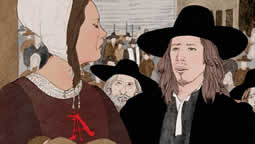
The seminar in class brought up the argument of who was worse because of his actions, Chillingworth or Dimmsdale? Chillingworth is obviously a bad person who lies constantly and is very manipulative, whereas Dimmsdale is an honest man--and a priest--who makes one mistake and has to lie to cover it up. Chillingworth feels no remorse for what he has done, but guilt is almost literally draining the life out of Dimmsdale. So who is more at fault? Chillingworth may have committed more sins than Dimmsdale, but it is more expected of Dimmsdale to be perfect. This situation reminds me of The Crucible. It reminds me of Abigail Williams and Proctor. Abigail lied and manipulated everyone and was purely evil, but Proctor was a good man who only made one mistake (which happened to be adultery, just like Dimmsdale!). In The Crucible, it was obvious that Abigail was evil and Proctor is a good person, but Proctor ended up dying for his mistake while Abigail got away. Does that mean that it's worse for a good person to do one bad thing than for a bad person--who has already done many bad things--to do one more? It's expected of a bad person to do bad things, but when a good person does something bad, it seems to be more severe of an offense. So basically, the message here is that it's ok for bad people to do bad things because that's who they are, but good people can't do bad things because they are supposed to be good. Everyone makes mistakes, so giving people who do a lot of bad things a break while punishing the people who never do bad things seems a little backwards to me!